In preparing for home teaching the other day, I considered the October First Presidency message in the Ensign, which is directed at new members of the Church. In it, President Hinckley mentions again the three things that every new convert needs: a friend, a responsibility, and nourishment by the good word of God.
As I pondered this message in relation to the family I would be teaching, I thought at first that it wouldn't apply and I considered finding another message to share. We don't have new converts around us; how would this family apply this message? Then I thought, as I have before, that those three things are important for all Church members, but the family I would be teaching does not include people in ward leadership positions where they could implement those suggestions to help others.
Then I thought—this blog is not titled "Think On (and on and on and ...)" for nothing—"But who's responsible for our individual salvation, anyway? Am I not ultimately responsible for my eternal destiny?"
So I turned the lesson into a conversation about how each of us individually can endure to the end. We are all "new converts" in a sense, and when you look at 2 Ne. 31, it is clear that we all need to "press forward with a steadfastness in Christ." And so President Hinckley's trio of directives works for all of us.
Each of us needs a friend, someone to help us through hard times, to welcome us warmly to activities and help us feel comfortable at Church. And if we don't have friends at Church, we should expend the effort to make friends. I recall when I was in Chicago and I had a hard time making friends in the ward. I made efforts, but I just couldn't click with anyone. Then I received a stake calling and suddenly my circle broadened dramatically and I found myself associating with people in other wards. I found the young single adults of the Spanish ward to be very welcoming and warm and friendly, and I began to spend more time with them. My whole experience in Chicago turned around in a significant way once I had some friends. The Lord knew I needed friends, and he recognized my unsuccessful efforts so he opened a way for me to have the friends I so desperately needed.
Each of us needs a responsibility. This one, at first glance, may seem like something we can do nothing about. Assignments and callings come from the bishop, right? Well, all of us are (or should be) home or visiting teachers. There's a responsibility, and it's a responsibility most of us could magnify more than we currently do. And then there are opportunities galore for volunteer service. When I returned from my mission, I didn't receive a calling in my ward for a long time, despite my requests for one. That lack of responsibility was terribly frustrating for me. I went from busy Church service to a big void. Then one day at the temple I thought I should go see if they needed help in the baptistry. They did, and it turned out that they always needed help in the baptistry. Before I left that day I was signed up to be a weekly temple worker in the baptistry. I vividly recall leaving the temple that day, walking out into the bright blue of a Saturday morning and feeling an immense swelling of joy and gratitude for the opportunity to serve. And I loved that job. I worked in the baptistry for about a year, and it was a marvelous experience I will always treasure.
Finally, each of us needs nourishing by the word of God. In the context of President Hinckley's injunction, we often think of lessons and talks at Church and the responsibility of leaders and teachers to make sure those lessons and talks are well prepared and spiritually guided. But the scriptures make it clear that we have an obligation to come prepared to be nourished (see D&C 50:19–22). And of course our nourishment should not be limited to Church meetings. We should be nourishing ourselves daily through our gospel study with our families and on our own. Twice during this recent General Conference, I felt gently chastized and lovingly encouraged to nourish myself better through my scripture study. Two speakers mentioned the need to not just study scriptures but to apply them to our lives. My goal is to do that—mostly through writing about what I read, reflecting on my reading in a personal journal.

Friday, October 13, 2006

Thursday, October 12, 2006
On Being an Ambassador
This afternoon I spent some time with the Indonesian ambassador to the United States. Not me alone—there were about nine people in the group—but a photographer and I were part of the entourage.
I was in the background, observing, most of the time, but I did have a few minutes to chat casually with the ambassador. I asked him about recovery efforts from the tsunami and he explained some of the challenges of managing the situation that have contributed to a slower-than expected process.
He was kind, bright, quick to smile, and very unassuming. He was attentive to and interested in me and what I had to say. It seems strange that after just a couple of hours in close proximity with someone, you can develop a personal connection, but I feel a certain kinship with him and his wife now. They were warm and gracious and personal.
While transcribing an interview today I came across a compelling quote from a professor. She was talking about the value of meeting individuals from other cultures; the more individuals one meets the better one understands a culture and realizes that the stereotypes don't apply universally to all members of that culture. "It’s so easy when we don’t know anyone [from a culture] to demonize [that culture]," she said. "And it’s so difficult when we do know someone to demonize them."
I have a very different view of Indonesia and Indonesians now than I did five hours ago. I have an appreciation, respect, and fondness for the country and its people born of a simple interaction with a kind man and his wife.
I guess that's the role of an ambassador. He served that role well today. I hope I reciprocated adequately.
Some fascinating facts about Indonesia that were new to me...
Population: more than 220 million (fourth largest country in the world, behind China, India, and the United States)
Geographic Size: about 3,200 miles from one end to the other, similar to the distance from Florida to Alaska
Geographic Composition: an archipelago of more than 17,000 islands (not all inhabited)
Languages: 731
Diversity: 500 different cultures
Monday, October 09, 2006
Wendy's Do-It-Yourself Salad (Tasty and Cheap)
I love Wendy's value menu. The options available for 99 cents have such a high value-to-cost ratio as to make everything else on the menu hardly worth a second glance. For a buck you can get a decent cheeseburger or even a bacon cheeseburger—complete with lettuce, tomato, onion, pickles, etc. You can also get fries, chicken nuggets, a good sized side salad, a baked potato, or a number of other entrees and sides.
For lunch today I had again my recent Wendy's favorite: a great do-it-yourself value-menu combo. It's a filling chicken salad that you can get for $2. Here's how:
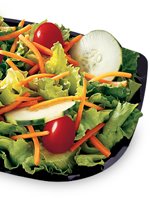 1. Order the side salad for 99 cents. I've tried the Caesar side salad (also 99 cents), but I prefer the other because it has more stuff (tomato, cucumber, carrots). The side salad comes with a few dressing options, which they'll ask you about. I've tried it with the ranch, which was good, but I actually prefer a nontraditional dressing (see step 3). These days I tell the person taking my order that I don't want a dressing.
2. The side salad does not come with croutons; those go with the Caesar side salad. However, I've found they'll give you croutons free if you ask. I like croutons, so I always ask.
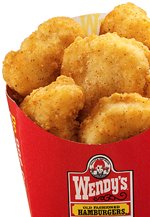 3. Order the 5-piece chicken nuggets, also for 99 cents. You have a number of sauce options. I love the honey mustard, which makes a tangy, sweet salad dressing. To get enough for the salad, though, you have to get two containers of the sauce, which they always provide for the asking.
4. The container the salad comes in isn't quite big enough to eat the salad in—without making a huge mess—so it helps to split it in half. The top of the container makes a nice second plate into which you can put half the salad.
5. To each half of the salad you can then add half of the chicken nuggets. The size of the nuggets exceeds polite single-bite morsels, so I like to break them into smaller pieces. This is easily done with your fingers, or there is a fork and a knife included with your salad—if you have scruples against finger food. (But if that's the case, why are you eating something from Wendy's 99-cent value menu?) I break each nugget into four to six smaller pieces.
6. If you opted for croutons, add half of the croutons to each half of the salad.
7. Add one container of honey mustard sauce/dressing to each half of the salad. The dressing is a bit on the thick side (remember, until a minute ago it was dipping sauce); the knife works well to extract it from the container and apply it to the salad.
8. Enjoy your tasty chicken salad and relish the fact that you only paid $2.22 (counting tax) while some other poor soul paid five bucks for a pre-made salad.
According to Wendy's Web site, this meal (not counting the croutons and one of the honey mustard dressing sides, because I don't know how to make their system calculate those extras) includes 370 calories, 24 grams of fat, 26 carbs, and 15 grams of protein. I'm afraid I don't pay enough attention to such things to know if that is good or not. But it's tasty. And cheap.
For lunch today I had again my recent Wendy's favorite: a great do-it-yourself value-menu combo. It's a filling chicken salad that you can get for $2. Here's how:
 1. Order the side salad for 99 cents. I've tried the Caesar side salad (also 99 cents), but I prefer the other because it has more stuff (tomato, cucumber, carrots). The side salad comes with a few dressing options, which they'll ask you about. I've tried it with the ranch, which was good, but I actually prefer a nontraditional dressing (see step 3). These days I tell the person taking my order that I don't want a dressing.
2. The side salad does not come with croutons; those go with the Caesar side salad. However, I've found they'll give you croutons free if you ask. I like croutons, so I always ask.
 3. Order the 5-piece chicken nuggets, also for 99 cents. You have a number of sauce options. I love the honey mustard, which makes a tangy, sweet salad dressing. To get enough for the salad, though, you have to get two containers of the sauce, which they always provide for the asking.
4. The container the salad comes in isn't quite big enough to eat the salad in—without making a huge mess—so it helps to split it in half. The top of the container makes a nice second plate into which you can put half the salad.
5. To each half of the salad you can then add half of the chicken nuggets. The size of the nuggets exceeds polite single-bite morsels, so I like to break them into smaller pieces. This is easily done with your fingers, or there is a fork and a knife included with your salad—if you have scruples against finger food. (But if that's the case, why are you eating something from Wendy's 99-cent value menu?) I break each nugget into four to six smaller pieces.
6. If you opted for croutons, add half of the croutons to each half of the salad.
7. Add one container of honey mustard sauce/dressing to each half of the salad. The dressing is a bit on the thick side (remember, until a minute ago it was dipping sauce); the knife works well to extract it from the container and apply it to the salad.
8. Enjoy your tasty chicken salad and relish the fact that you only paid $2.22 (counting tax) while some other poor soul paid five bucks for a pre-made salad.
According to Wendy's Web site, this meal (not counting the croutons and one of the honey mustard dressing sides, because I don't know how to make their system calculate those extras) includes 370 calories, 24 grams of fat, 26 carbs, and 15 grams of protein. I'm afraid I don't pay enough attention to such things to know if that is good or not. But it's tasty. And cheap.
Thursday, October 05, 2006
Lizzy-isms
A few Lizzy words and sayings worth sharing and recording before we forget them:
Words she has invented:
Trimenthesy: One-sixtieth of a second
Fewnormous: 100,000 times as big as our house
Fun pronunciations/variations of real words (some of which she is starting to lose as she reads more and realizes the order of letters in words):
planio (piano)
calipeter (catipillar)
sackerment (sacrament)
fravrite (favorite)
Cairline (Caroline)
oppositical (opposite)
hostipital (hospital)
permentheses (parentheses)
Observations:
"There's no such thing as magic, but there are magic words." (She got part of this from a Barney show about saying "please" and "thank you"; maybe the whole phrase.)
When I asked Lizzy to bless the food one morning, she consented but first corrected my language: "You mean 'say the prayer.' Heavenly Father's the one that blesses."
One day we were listening to one of my Lord of the Rings soundtracks in the car. She wanted to continue listening when we went inside, so I brought it in and put it in our three-CD stereo. When the soundtrack ended, the next CD, which happened to be a CD of Primary songs, automatically began to play. Shocked by the dramatic change in music (think Mordor juxtaposed against carefree children), Lizzy said: "This isn't Lord of the Rings. [pause] Is this a mix?"
Sometime early this summer, Christine or I commented that it had been a quiet month (can't remember now what that was in reference to; I believe it was some metaphorical sense, like a quiet news day or something like that). At the time, however, Caroline was in the middle of a long sad spell; she had been very sad all day every day. When Lizzy heard our comment about it being a quiet month, she responded matter of factly: "It's not a quiet month for us."
Several weeks ago a rather spectacular thunder storm rolled through one evening. Christine went into Lizzy's room to comfort the nervous and not sleeping child. After Christine assured Lizzy that she would be safe, Lizzy responded, "But in Reader's Digest it told about a house that got hit by lightning." (The curse of an early reader.)
And my "fravrite" observation: "Dad, you're ingenious!"
Wednesday, September 27, 2006
Cool Gospel Study Idea
Just stumbled across this Web page and I thought it was a great family gospel study idea—worth sharing:
http://www.truelightacademy.com/sacred_art_appreciation.html
You could do this with poetry or music, too. Study a bunch of sacred music by Bach or Handel or whoever else for several weeks. Reminds me of when I attended performances of Bach's B-Minor Mass and one of his passions (St. Matthew or St. John, can't remember which I heard). Stunning pieces of music, several hours long. Inspiring, uplifting, moving.
Here's an article we did about a BYU class that performed those long sacred works. They would spend months preparing for the performances and they would perform in sacred buildings: Salt Lake's Cathedral of the Madeleine, the Provo Tabernacle. I don't think the class exists anymore, which makes me sad. I loved those performances. When Christine and I were dating we went to a performance of the Messiah by this class at a Catholic church in Park City. Powerful.
Subscribe to:
Posts (Atom)